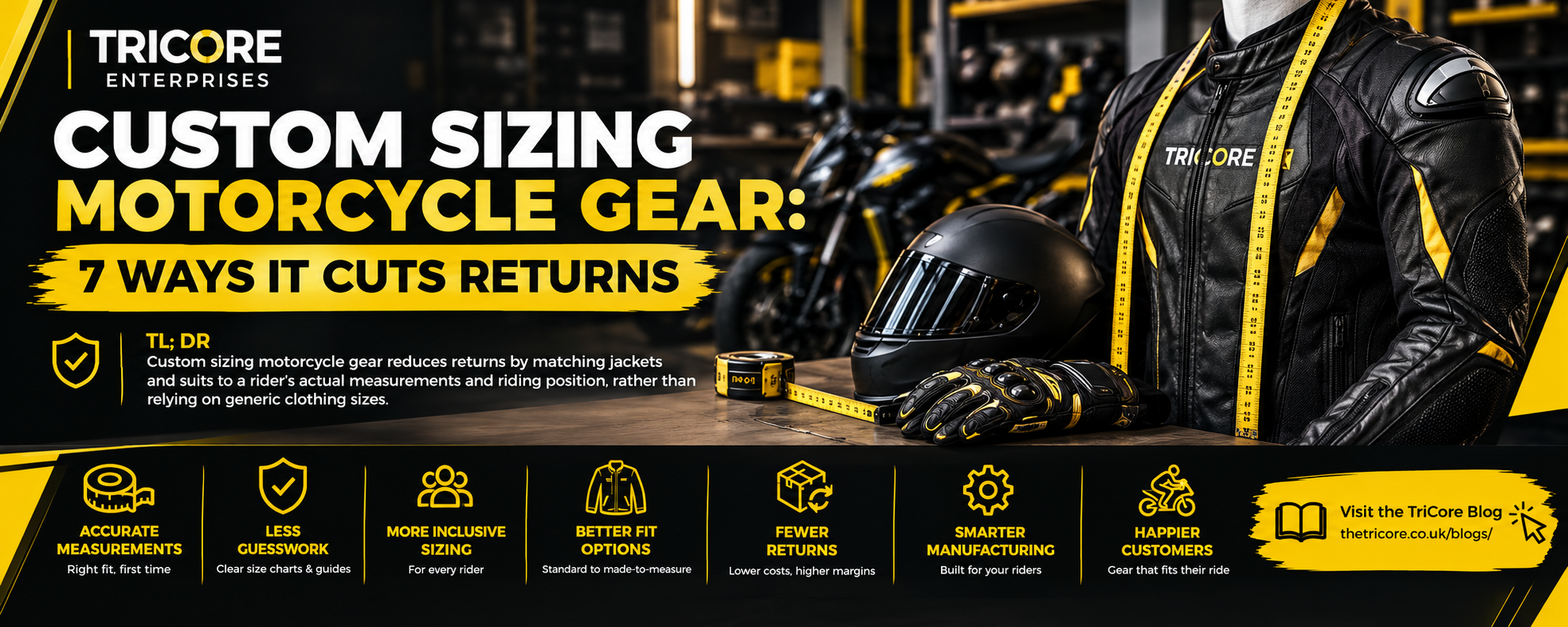
Custom Sizing Motorcycle Gear: 7 Ways It Cuts Returns
Custom Sizing: Fewer Gear Returns
Custom Sizing Motorcycle Gear: 7 Ways It Cuts Returns
TL; DR Custom sizing motorcycle gear reduces returns by matching jackets and suits to a rider’s actual measurements and riding position, rather than relying on generic clothing sizes. Retailers that offer made-to-measure options, clear size charts, and measurement guidance typically see fewer fit-related returns, though results depend on measurement accuracy, garment construction, and internal processes.
A customer can love the color, the price, and the styling of a motorcycle jacket, and still send it back because the shoulders pull or the sleeves swallow their hands. Fit, not design, is the quiet reason behind a large share of motorcycle gear returns.
Every one of those returns costs more than the price tag suggests. Someone has to process the return label, inspect the garment for wear, restock it correctly, answer the customer-service email, and often issue a refund before a replacement ever ships. Multiply that across hundreds of orders a month, and fit-related returns become a measurable drag on margin and staff time.
Custom sizing motorcycle gear addresses the root problem instead of managing its symptoms. By collecting better measurements upfront, offering extended or made-to-measure options, and setting clearer expectations before checkout, retailers can help more customers get the right fit on the first try.
This article walks through why motorcycle gear returns happen, what custom sizing actually involves, seven practical ways it can reduce returns, and how to evaluate a manufacturing partner for made-to-measure motorcycle jacket sizing.
01
Product Fit Development
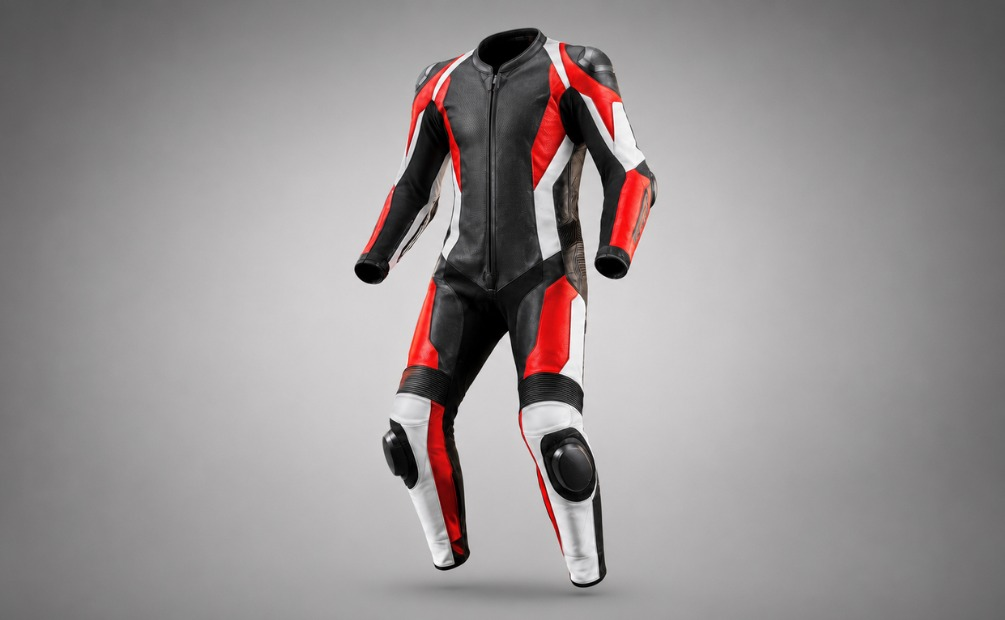
01 — Product Fit Development Develop motorcycle jackets and suits around accurate measurements to improve fit and reduce returns.
02
Accurate Size Charts
Detailed measurement charts help customers choose the correct size before placing an order.
03
Custom Sizing Options
Made-to-measure gear accommodates different body shapes, shoulder widths, and sleeve lengths.
04
Inclusive Size Ranges
Extended sizing gives more riders access to comfortable gear that fits their individual needs.
CUSTOM SIZING MOTORCYCLE GEAR: 2 WAYS TO CUT RETURNS
The right fit makes a difference. Discover two practical ways to improve motorcycle gear sizing, reduce avoidable returns and build customer confidence.
Pre-Dispatch Quality Checks
Verify measurements, stitching and product specifications before shipping to help prevent sizing errors and avoidable returns.
Accurate Product Fit Descriptions
Provide clear size charts, body measurement guidance and fit descriptions so customers can choose the right motorcycle gear before ordering.

Explore motorcycle clothing customization for your brand, your customers and your business.
Ready to Customize Your Gear?
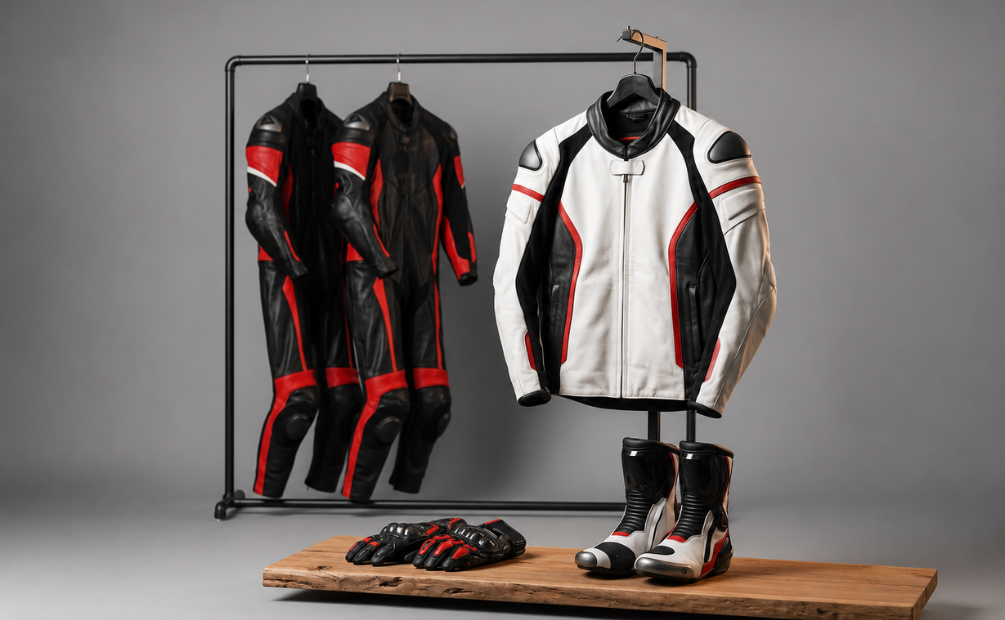
Explore custom motorcycle jackets, racing suits and personalized gear options with TriCore.
Explore Custom Sizing →Why Gear Gets Returned
Why Motorcycle Gear Returns Happen
Motorcycle jacket fit problems rarely come down to a single cause. They usually stem from a mismatch between how a garment is sized, how it’s described, and what the customer expects when the box arrives.
Standard sizing does not fit every rider’s body
Standard size ranges are built around average body proportions. Riders with broader shoulders, longer torsos, or a build outside the typical curve often find that no single size works for their entire frame — the chest fits but the sleeves are short, or vice versa.
Casual clothing measurements do not always translate to riding gear
A customer who knows their t-shirt size in casual clothing can still order the wrong motorcycle jacket size. Riding gear is cut differently to accommodate armor, layering, and a forward-leaning posture, so casual sizing assumptions frequently don’t carry over.
Incorrect sleeve length, shoulder width, chest fit, and waist fit
These four measurements account for most motorcycle jacket fit complaints. A jacket that’s correct through the chest but too long in the sleeve, or snug at the shoulder but loose at the waist, feels wrong the moment a rider puts it on.
Riding Position Fit
Designing for sport, touring, and upright riding positions improves comfort and garment fit.
Reduced Return Costs
Better sizing reduces fit-related returns, saving time on refunds, inspections, and restocking.
Better Measurement Guidance
Clear measuring instructions help customers provide accurate body measurements when ordering online.
Improved Customer Satisfaction
A better first-time fit builds customer confidence and encourages repeat purchases.
Adjustable Fit Features
Adjustable cuffs, waist tabs, and stretch panels accommodate minor differences in body shape.
Flexible Manufacturing Growth
The right manufacturing partner supports custom sizing, consistent quality, and long-term business growth.
Comfortable Endurance Fit
Differences between casual, touring, sport, and race-oriented fits
A sport-cut jacket is designed for a forward lean on the bike, while a touring jacket allows more room for an upright seating position and extra layers. A customer who doesn’t realize these cuts differ may order their “usual size” in the wrong category entirely.
Unclear size charts and inaccurate product expectations
When a size chart lists only generic small, medium, and large labels without body measurements, customers are left guessing. That guesswork, combined with product photos that don’t show fit on different body types, sets up expectations that the actual garment can’t always meet.
What Is Custom Sizing in Motorcycle Gear?
Custom sizing motorcycle gear covers a spectrum of options, not a single product type. Understanding where a garment sits on that spectrum helps retailers decide what to offer.
Standard sizes versus extended sizes versus made-to-measure gear
Standard sizes follow a fixed chart across a limited range. Extended sizing expands that range to cover more body types while keeping the same production process. Made-to-measure motorcycle jackets are cut and constructed around an individual customer’s specific measurements, offering the closest possible fit but requiring more production time.
measurements matter
Which body measurements matter for motorcycle jackets and suits?
Chest, waist, shoulder width, sleeve length, and torso length form the core measurement set for most motorcycle jacket sizing. Depending on the garment design, manufacturers may also request neck size, arm circumference, or inseam length for full suits.
How rider posture influences garment fit
A jacket cut for an upright touring position will sit differently on the body than one cut for a crouched sport-riding stance. Posture affects where fabric needs to stretch, how armor pockets align, and how much room the back panel needs—which is why riding position should factor into sizing decisions, not just body measurements alone.
When adjustable fit options may be enough
Not every fit issue requires made-to-measure production. Adjustable cuffs, waist tabs, and stretch panels can accommodate minor variations in body shape for customers who are close to a standard size but need small adjustments.
7 Ways Custom Sizing and Fit Options Can Reduce Returns
Custom motorcycle jacket sizing addresses fit problems at several points in the buying journey. Here are seven ways it can help lower return rates.
Match products more closely to individual measurements
Matching a jacket to a customer’s actual chest, waist, and sleeve measurements, rather than a generic size label, reduces the chance of a garment arriving noticeably too tight or too loose. A retailer offering a simple measurement form at checkout, cross-referenced against a manufacturer’s size chart, can catch mismatches before the order ships.
Reduce guesswork during online purchasing
Online shoppers can’t try a jacket on before buying. Providing a detailed, garment-specific size chart with body measurements—not just S/M/L labels—reduces the guesswork that leads to ordering the wrong size. Retailers can implement this by publishing a measurement chart alongside every product listing, not just on a general sizing page.
Offer more inclusive sizing options
Extended sizing or made-to-measure production accommodates riders whose measurements fall outside a standard chart. A retailer that only stocks a narrow size range will see more returns from customers at the edges of that range; expanding available sizes gives those customers a realistic chance of a correct first order.
Improve comfort in the intended riding position
A jacket that fits well standing still can still feel wrong on the bike if it wasn’t cut for the rider’s intended posture. Asking customers whether they primarily ride touring, sport, or casual style, and recommending a cut accordingly, helps prevent returns driven by on-bike discomfort rather than static fit.
Set clearer expectations before checkout
Confirming measurements, cut, and intended use before an order is finalized gives customers an accurate picture of what they’re buying. A short pre-checkout confirmation step — even a simple summary of the selected measurements — can catch errors before production or dispatch rather than after delivery.
Address recurring fit complaints through product feedback
Reviewing return reasons by product and size reveals patterns, such as a specific jacket model running small in the shoulder. Retailers can feed this information back into their size charts and product descriptions, correcting the same mistake before it generates more returns.
Help customers select the right fit before dispatch
Offering a brief sizing consultation, whether through live chat, email, or a measurement-verification call, gives uncertain customers a chance to confirm their order before it’s produced or shipped. This is particularly useful for made-to-measure motorcycle jacket sizing, where a confirmed measurement step before production can prevent a costly remake.
Standard Sizing vs. Custom Sizing for Motorcycle Gear Retailers
Neither approach is universally better. The right choice depends on the customer, the product, and the retailer’s operational capacity.
|
Factor |
Standard Sizing |
Custom Sizing |
|
Fit flexibility |
Limited to a fixed-size chart |
Matched to individual measurements |
|
Ordering complexity |
Simple, single size selection |
Requires measurement collection |
|
Lead time |
Immediate dispatch from stock |
Longer production turnaround |
|
Inventory requirements |
Higher stock across sizes |
Lower stock, made to order |
|
Customer guidance |
A basic size chart is usually sufficient. |
Detailed measurement guide needed |
|
Return-handling considerations |
Higher risk of fit-related returns |
Lower risk, but harder to resell if returned |
Standard sizing remains a sound choice for customers who fit established size ranges and want their gear quickly. Custom-sized motorcycle gear is better suited to riders outside typical proportions or those who prioritize fit accuracy over speed of delivery.
How to Build a Better Motorcycle Gear Sizing Process
A stronger sizing process combines clear information with a few checkpoints before an order is finalized.
- Create a clear, garment-specific size chart. List actual body measurements for each size, not just generic labels, and tailor the chart to each product rather than using one chart for the entire catalog.
- Provide a step-by-step measurement guide. Show customers exactly how to measure their chest, shoulders, sleeve length, and waist using a tape measure, with simple diagrams where possible.
- Ask about the intended riding position and layering. A short checkout question about touring, sport, or casual use—and whether the customer plans to wear thermal layers underneath—helps match the right cut.
- Offer human sizing support for uncertain customers. A live chat option or dedicated sizing email line catches hesitant buyers before they guess and order the wrong size.
- Confirm measurements before custom production. For made-to-measure orders, send a summary of recorded measurements for the customer to approve before cutting begins.
- Set transparent policies for alterations, exchanges, and customized items. Make clear upfront whether custom or made-to-measure items are eligible for exchange and under what conditions.
Retailers evaluating custom motorcycle gear sizing and fit options as part of a made-to-measure program should build these checkpoints into the ordering workflow from the start, rather than adding them after returns start accumulating.
Packaging & Unboxing Support
The customer experience does not end when the product is manufactured. Packaging is the first physical interaction a customer has with an online brand. Professional, branded packaging can make a product feel more valuable and memorable.
For businesses researching custom branded jacket packaging manufacturers, it is worth asking. whether the manufacturing partner can support branded packaging, labels, tags, inserts, or other presentation requirements.
A well-designed unboxing experience can strengthen brand perception and encourage
customers to share their purchase online.
Compliance & Material Sourcing Transparency
Today’s customers increasingly want to know what they are buying and where it comes from.
For motorcycle and leather products, manufacturers should be able to communicate relevant
information about materials, construction, protective components, testing, and applicable
certifications.
This information can help e-commerce brands create more trustworthy product pages and
marketing claims. Material transparency also gives brands greater confidence when entering new markets or working with wholesale customers. If a manufacturer cannot clearly explain its materials, production standards, or documentation, that should be considered when evaluating the partnership.
Questions to Ask a Manufacturer Before Partnering
Before choosing a leather jacket wholesale supplier or OEM partner, ask questions that go beyond the basic product price.
Consider asking:
What are your minimum order quantities?
Can you provide samples before bulk production?
What is your typical production turnaround time?
Do you support small-batch or made-to-order production?
What customization options are available?
Can you provide accurate size charts and product specifications?
How do you maintain quality consistency?
What communication process do you use during production?
What documentation or compliance information can you provide?
Brands looking for a long-term manufacturing relationship can also explore how to become a
vendor with us. The goal is not simply to find the cheapest factory. It is to find a partner capable of supporting your business as it grows.
The Business Impact: Measuring Fit-Related Return Reduction
Tracking the right metrics shows whether sizing improvements are actually working.
Track return rates by product and size
Breaking down returns by individual product and size reveals which items are driving fit complaints, rather than treating returns as a single undifferentiated number.
Separate fit-related returns from defects and delivery issues
Lumping fit complaints together with damaged goods or late deliveries hides the true scale of a sizing problem. Tagging return reasons at intake keeps the data useful.
Measure exchange rates, repeat purchases, and customer satisfaction.
A rising exchange rate alongside falling returns can indicate customers are finding a better-fitting size rather than giving up on the purchase entirely. Repeat purchase rates and satisfaction scores offer additional context.
Calculate the operational cost of avoidable returns.
Use the following formula to track progress:
Fit-related return rate = fit-related returned orders ÷ total fulfilled orders × 100
Compare a baseline period against a later period after sizing changes are introduced, while accounting for shifts in product mix and seasonal demand.
Choosing a Motorcycle Gear Manufacturing Partner for Custom Fit Options
Selecting the right manufacturer determines whether custom sizing motorcycle gear programs actually deliver on their promise.
Ask about measurement specifications and production tolerances.
Confirm exactly which measurements the manufacturer requires and how much tolerance their production process allows for each.
Check sample fitting and quality-control procedures.
A manufacturer that offers sample fittings and documented quality checks reduces the risk of recurring fit errors across a product line.
Understand minimum order quantities and lead times.
Custom and made-to-measure production often involves different minimum order quantities and longer lead times than standard stock. Confirm these details before committing to a program.
Confirm how custom orders and alterations are handled
Ask how the manufacturer handles mistakes, alterations, or remakes on custom orders, and what that process costs.
Assess the manufacturer’s ability to support your product range
A manufacturer experienced across motorcycle jackets, riding suits, and related gear is better positioned to support a growing custom sizing program than one limited to a single product type.
TriCore works with retailers on motorcycle gear manufacturing and custom racing leather manufacturing, offering motorcycle jacket sizing options that range from extended standard sizes to fully made-to-measure production. Retailers exploring a custom motorcycle gear manufacturer relationship can use the questions above to evaluate fit, capacity, and quality-control processes before committing to a wholesale or private-label arrangement.
Custom Motorcycle Gear Sizing and Returns
FREQUENTLY ASKED QUESTIONS
1.How does custom sizing reduce returns for motorcycle gear retailers?
Custom sizing can reduce fit-related returns by matching a garment more closely to a customer’s measurements and intended riding position. Clear measurement instructions, fit consultations, and pre-production measurement checks can further reduce sizing mistakes. Results depend on measurement accuracy, garment construction, and the retailer’s processes.
2. Why do customers return motorcycle jackets purchased online?
Common reasons include incorrect chest or shoulder fit, sleeves that are too long or short, uncomfortable movement, unclear size charts, and differences between expected and actual fit. Retailers should review return reasons by product and size to identify recurring issues.
3. Is made-to-measure motorcycle gear better than standard sizing?
Made-to-measure gear can offer a closer fit for riders whose measurements fall outside standard size ranges or who need specific fit adjustments. Standard sizing is often more convenient for customers who fit established size charts and want quicker dispatch. The better option depends on the rider, product, budget, and delivery requirements.
4.What measurements are important when ordering a custom motorcycle jacket?
Common measurements include chest, waist, shoulder width, sleeve length, torso length, and sometimes neck and arm circumference. The exact requirements depend on the garment design. Retailers should use the manufacturer’s measurement guide rather than relying on generic clothing sizes alone.
5.Can adjustable motorcycle jackets help reduce returns?
Yes. Adjustable cuffs, waist tabs, sleeves, and other fit features can accommodate some differences in body shape. However, adjustments cannot compensate for every sizing mismatch, so a suitable base size and clear product measurements remain important.